


WIF’s scholarships have enhanced the capacity of Kiribati youth on mobile phone video reporting, leading to climate actions by planting mangroves.
Mobile Phone Video Reporting Training
9-12 young trainees from one or some of the small state islands will be selectively recruited and intensively trained (3-5 days) to acquire new skills in climate change video reporting using mobile phone technologies. Compulsarily, trainees will produce video reports individually and in groups as an exercise during the late part of training sessions. Dissemination and uploading of these video reports will be sent or uploaded to various social media networks/platforms such as Youtube, Facebook, TikTok., etc.
9-12 young trainees from one or some of the small state islands will be selectively recruited and intensively trained (3-5 days) to acquire new skills in climate change video reporting using mobile phone technologies.
WIF will create a network platform for communication and video report sharing among these ex-trainees, forming their own “Generation HOPE.” This initial group will gradually expand and connect to the now available, like-minded environment-awareness global networks.
Compulsarily, trainees will produce video reports individually and in groups as an exercise during the late part of training sessions. Dissemination and uploading of these video reports will be sent or uploaded to various social media networks/platforms such as Youtube, Facebook, TikTok., etc.




In parallel, to support and strengthen the Generation HOPE reporting process, we will also create a supplementary online study course entitled “How to use mobile phone for video reporting.”
We will document our first training session to create course media content.
Course content will involve journalistic skills and knowledge on global warming, climate change, blue carbon climate solutions, and finally, WIF’s mangrove planting and rehabilitation with ten years of experience.
From 6th—10th May 2024, WIF, in cooperation with the Rotary Club of South Tarawa, organized a 5-day practical workshop for 12 selected young climate activists from the island nation of Kiribati. This transformative experience equipped these young individuals with the skills and knowledge to report climate change stories from their communities and gear up to raise local and global awareness of sea-level rise affecting their island country.
WIF key partner in Kiribati.
With assistance from Ruth Cross, President of the South Tarawa Rotary Club and a development expert in Kiribati, on her popular social media announcements, calling for scholarship applications from the youth groups in the country. She has also accepted the WIF proposal to jointly implement the pilot project to involve Kiribati youth and coastal communities in protecting their coastal shorelines from extreme ocean causes from the rising sea. Mangrove planting and rehabilitation is the ultimate aim of the pilot project.
Mobile Phone Video Reporting.
Pongtada Suriya, WIF’s Communication Specialist from Thailand, recruited young applicants from the online mobile phone video reporting course he developed in early 2024. Out of 242 application entries, he selected 12 workshop participants based on their outstanding performances. WIF has also publicized another free online course on mangrove rehabilitation, which is available at https://manggrove-virtual.university. This website reinforces the practical knowledge of mangrove planting based on WIF’s ten years of experience in mangrove rehabilitation and restoration projects listed by VERRA.
Practical skills training.
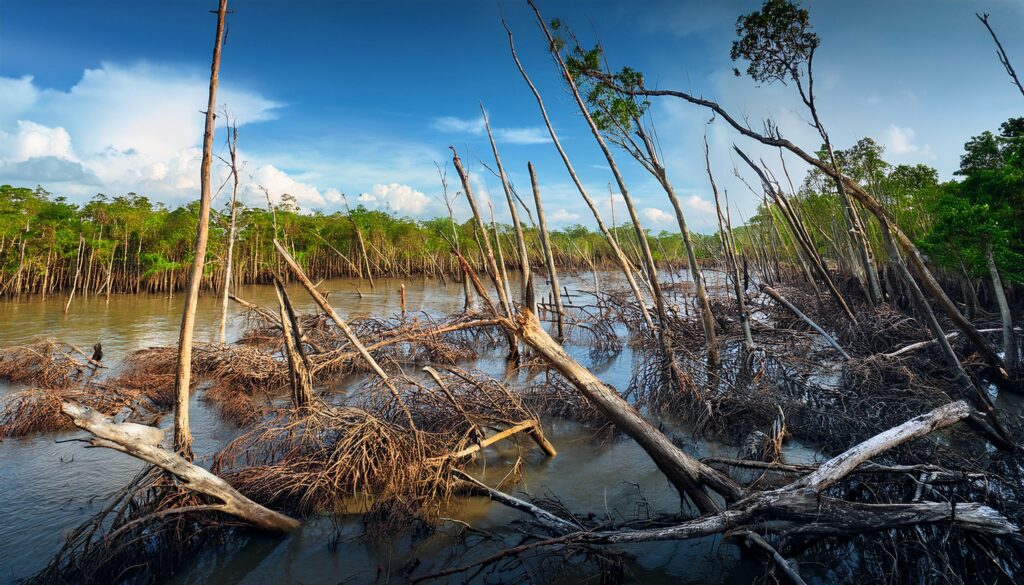
During the workshop, video reports were produced covering urgent stories such as drought and salt-water intrusion, coastal erosion, and sea-level rises affecting coastal communities. These stories underscore the importance and urgency of mangrove planting to protect the shorelines, leaving us all concerned and motivated.
Youth group organization.
At the end of the workshop, Ruth invited workshop graduates to a Rotaract Youth Club, the junior social organization of Rotary International branches, and most of them joined. Miss Miriam Moriati Koae, the outstanding workshop graduate from Tarawa, leads the club and prepares to implement social and livelihood projects with her team.
WIF has continued supporting its post-workshop activities in Kiribati, activating these youth’s climate change-related video reports. It seeks to locate mangrove planting areas in Kiribati coastal settlements for a pilot tree planting project.
Communication is the key to progress.
Internet data access and communication are among the main obstacles to project activities. They are expensive and beyond the economic capacity of the unemployed youth to acquire. WIF has granted a monthly internet data plan for selected active youth members who have worked with us continuously.
Climate Action by the Youth for their Future.
To start tree planting projects, Miriam, the group leader, has made direct contact with the ECD-Environment and Conservation Division under the Ministry of Environment Lands and Agricultural Development (MELAD) to get support. Four people have been assigned to support the Rotary Youth Club. The first activity is collecting seeds/propagules.
The team collected ripe seeds/propagules from the Tanaea community area near the Coastal Fisheries Office. On Friday, August 2, 2024, 20 people collected 2,495 propagules. The propagules were stored in safe places and checked for quality control.
Planting day! On Friday, August 9, 2024, the youth team of 20 people, including three mangrove officers from MELAD, planted 1,747 trees at the front of the Tobwaan te Tongo Park shoreline in Bonriki Area, South Tarawa.
For experimental purposes, 100 and 500 seeds were kept at Miriam’s home and MELAD Office, respectively. The purposes are:- (1) to find possible solutions to keeping these seeds through until the wet seasons. (2) to compare the viability between bare root and nursery-raised seedlings with plastic bags.
Generation Hope goes Global.
Through our Generation Hope pilot project in Kiribati, we will raise awareness of local communities and global levels, reflecting the climate change adaptation of the Small Island Development States (SIDS). There is enormous potential in the island countries of the Maldives, Timor-Leste, etc.